

Introduction
If you've ever sourced a custom protective case, you've probably seen "EVA material" listed in a supplier's spec sheet. But here's the thing: that description alone doesn't tell you much.
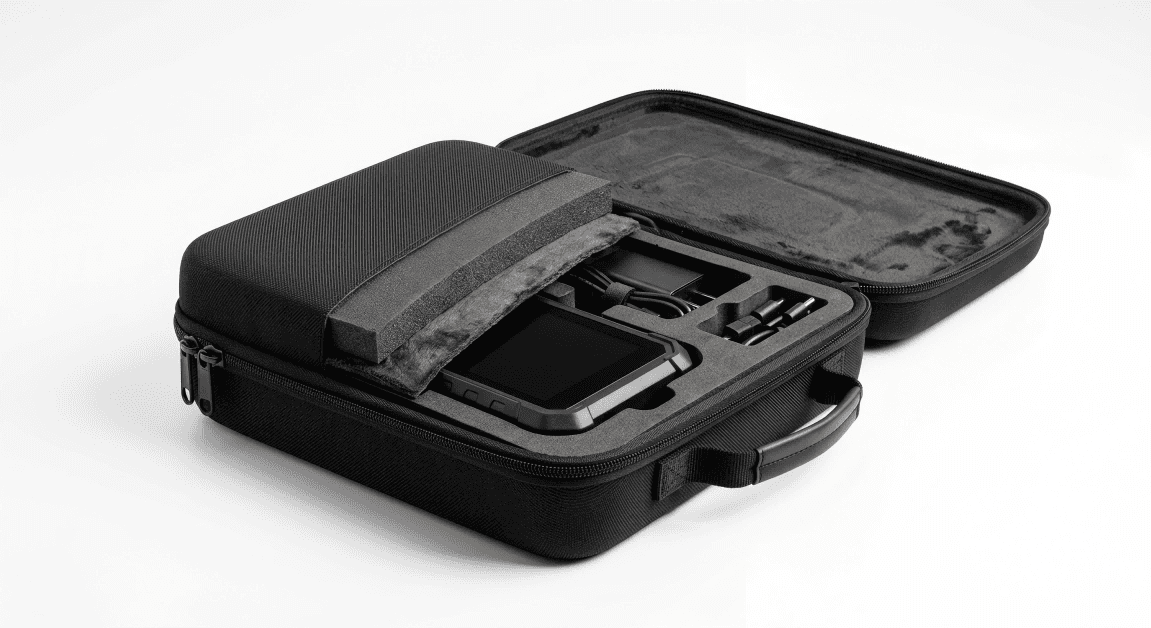
In most professional applications, EVA isn't the outer shell of the case. It's the foam core — the structural layer sandwiched between an outer fabric and an inner lining. The outer layer is usually made from Oxford fabric, PU leather, nylon, or another laminated textile. The EVA sits in the middle, providing rigidity and shock absorption.
This guide is about one of the most important decisions you'll make when designing a custom case: choosing the right EVA foam core density.
Get it wrong, and your case might be too flimsy to protect the product inside. Or it might be over-engineered, driving up cost without improving performance. Get it right, and you'll have a case that's protective, cost-effective, and manufacturable at scale.
Important clarification: This guide focuses on semi-rigid protective cases with an EVA foam core and a fabric outer layer. It does not cover full EVA outer-shell cases or hard plastic cases.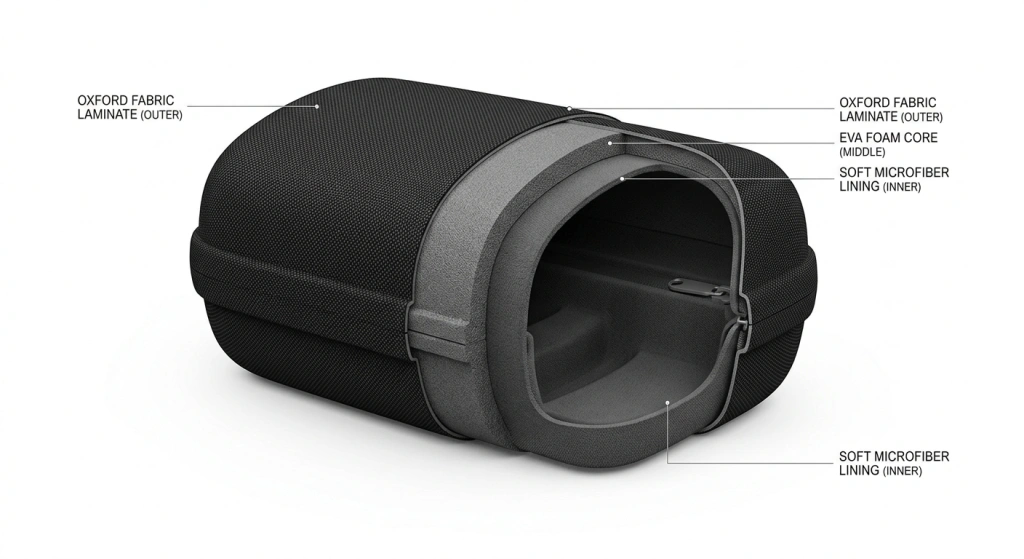
Understanding Density vs. Hardness
Before we dive into density selection, let's clear up a common point of confusion: density and hardness are not the same thing.
Density refers to how much material is packed into the foam. It's measured in kilograms per cubic meter (kg/m³). Think of it as the "weight" of the foam structure.
Hardness refers to how much the foam resists indentation. It's usually measured on the Shore C or Asker C scale. Think of it as the "feel" of the foam.
You can have a high-density foam that's still relatively soft, or a lower-density foam that feels firm. It all depends on the formulation, foaming process, and curing conditions.
When you're sourcing a case, you should specify both values. For example:
"We need 70 kg/m³ EVA foam core with 65 Shore C hardness."
This gives the manufacturer a clear target and helps ensure consistency across samples and production runs.
Matching Density to Your Product's Weight
The main job of a protective case is to absorb impact. When the case is dropped, the EVA foam core compresses and distributes the force before it reaches the device inside.
The key is to match the foam density to the weight of the product you're protecting.
If you put a heavy item — like a power tool or medical device — into a low-density case, the foam might compress completely on impact. This is called "bottoming out." Once that happens, the foam can't absorb any more shock, and the force transfers directly to your product.
On the other hand, if you use a very high-density foam for a lightweight item like earbuds or a small accessory, the case might feel too rigid. The product could bounce around inside instead of being gently cushioned.
Practical Recommendations
Here's a starting point based on payload weight:
Lightweight products (under 2 lbs):
35–45 kg/m³
Best for compact consumer accessories. Provides soft cushioning and keeps the case lightweight.
Medium-weight products (2–8 lbs):
60–75 kg/m³
This is the sweet spot for most custom protective cases. It balances rigidity with shock absorption.
Heavy-duty products (over 8 lbs):
80 kg/m³ and above
Best for tools, medical equipment, and industrial devices. Helps prevent bottoming out and improves crush resistance.
If you're not sure where your product falls, start with a medium-density prototype and validate it through drop testing.
How Density Affects Manufacturing
Density doesn't just affect protection — it also affects how easy the case is to manufacture.
Most custom cases are made using a process called thermoforming. The EVA foam sheet (already laminated with the outer fabric) is heated and pressed into an aluminum mold. As the material stretches into the mold cavity, the foam structure changes shape under pressure.
The higher the density, the less the foam wants to stretch. This becomes a problem when your case design includes:
- Deep cavities
- Sharp corners
- Complex curves
- Thin wall transitions
If the density is too high for the geometry, the material might tear at the corners, thin out unevenly, or fail to conform to the mold properly.
For cases with complex shapes, medium-density EVA in the 65–70 kg/m³ range is often the most practical choice. It provides enough stiffness for protection while maintaining the flexibility needed for stable forming.
This is why density selection should always be discussed alongside tooling design and mold geometry.
The Cost Equation
From a procurement perspective, density has a direct impact on cost.
EVA foam is sold by weight. A case made with 80 kg/m³ foam uses more raw material than a case of the same size made with 45 kg/m³ foam. That means higher material cost and, in many cases, higher production cost as well.
Logistics are also affected. High-density cases weigh more, which increases freight costs — especially for large-volume orders.
Over-specifying density is one of the easiest ways to reduce margin without improving real-world performance. The better approach is to select the minimum viable density that passes your drop test, stack load, and compression requirements.
In other words: don't over-engineer the foam. Engineer it to the actual risk profile of the product.
Quick Reference: Industry Standard Densities
Here's a practical starting point for different product categories:
Consumer Electronics
Examples: headphones, keyboards, controllers, small accessories
Recommended density: 45–60 kg/m³
Priority: lightweight portability, clean appearance, moderate protection
Medical Devices
Examples: monitors, CPAP machines, portable diagnostic tools
Recommended density: 70–75 kg/m³
Priority: stiffness, crush resistance, transport safety, stable internal fit
Drones and Camera Equipment
Examples: drones, cameras, lenses, microphones
Recommended density: 65–70 kg/m³ for the structural layer, paired with softer internal foam for the insert
Priority: shock absorption, device stabilization, premium presentation
Industrial and Military Equipment
Examples: rugged tools, instruments, field equipment
Recommended density: 80 kg/m³ and above
Priority: maximum crush resistance, stacking strength, transit durability
These values are a useful starting point, but the final specification should always be validated against your exact product weight, geometry, and required drop standard.
Understanding the Full Case Structure
In most custom protective cases, the product isn't made from EVA alone. The finished case is a composite structure with multiple layers.
Here's what a typical semi-rigid protective case looks like:
Outer layer:
Oxford fabric, PU leather, nylon, polyester, or water-resistant laminated textile. This layer provides appearance, abrasion resistance, and weather protection.
Middle layer:
EVA foam core. This is the structural layer that provides rigidity and shock absorption.
Inner layer:
Soft lining material like brushed fabric, velvet, or polyester. This protects the product from scratches and adds a premium feel.
Insert:
Die-cut foam, molded foam cavity, or custom compartment layout. This holds the product securely in place.
This layered construction is important because each layer serves a different function. The outer fabric affects appearance and durability. The EVA core provides structure and impact protection. The inner lining adds comfort and finish quality.
For procurement teams, this means your material specification should always distinguish between:
- Outer fabric type
- EVA foam core density
- EVA foam core hardness
- Inner lining material
- Insert structure
- Stitching and zipper construction
A complete specification prevents misunderstandings and helps the manufacturer quote accurately.
How to Specify EVA Density in Your RFQ
If you're preparing a request for quotation, the density should never be listed by itself. A good RFQ should include the following details:
- EVA foam core density (e.g., 65 kg/m³)
- EVA foam core hardness (e.g., 70 Shore C)
- Outer material (e.g., Oxford fabric / PU / nylon)
- Inner lining material (e.g., brushed fabric / velvet / polyester)
- Case structure (semi-rigid thermoformed case with EVA foam core)
- Insert type (die-cut foam / molded insert / custom compartments)
- Target product weight
- Required drop height
- Compression or stacking requirement
- Waterproofing requirement
- Sample approval standard
Example RFQ Wording
"We require a custom semi-rigid protective case with an EVA foam core at 65 kg/m³ density and 70 Shore C hardness. The outer layer should be Oxford fabric with a laminated finish, with a soft polyester lining and custom die-cut internal insert suitable for a 3.5 lb electronic device. The case must pass drop testing from 1 meter."
This level of detail significantly improves quotation accuracy and sample consistency.
Common Mistakes When Choosing EVA Density
Mistake 1: Choosing density based on appearance
A case may look premium but still fail impact protection if the density is wrong.
Mistake 2: Using the same density for every product
Different payload weights require different support levels.
Mistake 3: Ignoring thermoforming limits
Very high density can create production issues in deep or complex molds.
Mistake 4: Forgetting the outer fabric layer
If the outer shell is Oxford fabric or PU, the perceived feel of the case may differ from the actual foam core performance.
Mistake 5: Not testing with real payloads
Foam should always be validated with the actual device inside, not just as a standalone sample.
How to Verify the Manufacturer Used the Correct Density
To verify EVA foam core density, you'll need to test a sample from the raw foam sheet before full forming if possible. Don't rely only on the finished corner area, since thermoforming can alter the foam structure and thickness.
Here's the method:
- Cut a clean rectangular or square sample
- Measure the exact dimensions
- Calculate the volume in cubic meters
- Weigh the sample in kilograms
- Divide mass by volume to obtain density in kg/m³
If you're working with a manufacturer, request material documentation, sample photos, and production consistency checks before mass order approval.
Final Recommendation
The right EVA density isn't the highest density available. It's the density that best matches your product weight, drop requirement, case geometry, and cost target.
As a general rule:
- Lightweight consumer goods: 35–45 kg/m³
- Mid-weight electronics and accessories: 60–75 kg/m³
- Heavy-duty medical and industrial products: 80 kg/m³ and above
When in doubt, start with a medium-density prototype and validate it through real-world testing. The best protective case isn't just protective — it's engineered to be protective at the lowest practical cost.
FAQ
Can I use different EVA densities in the same case?
Yes. This is common in professional case engineering. We often recommend a higher-density EVA layer for the thermoformed outer structural shell to improve rigidity and crush resistance, combined with a lower-density internal foam insert to gently cradle sensitive devices.
How do I test whether the manufacturer used the density I specified?
You can measure it manually. Cut a precise square sample from the raw EVA sheet, measure its volume, weigh it, and calculate density using mass divided by volume. For best accuracy, test the foam before thermoforming because heat and stretching can affect the finished shape.
Does the outer fabric change the EVA density?
No. Laminating Oxford fabric, PU, or nylon to the outside does not change the core foam density. However, it may affect the perceived stiffness and surface finish of the final case. That's why the foam core must be specified and tested separately.
What outer materials are commonly used with these cases?
Common outer materials include Oxford fabric, PU leather, nylon, polyester, and water-resistant laminated fabrics. The EVA foam sits inside as the structural layer.
What should I send to a manufacturer to get an accurate quote?
You should provide product dimensions, weight, target drop test standard, desired density, hardness, outer fabric type, insert layout, color, logo requirements, and expected order quantity.